Triangulating a GG-Grandparent from DNA
This post is about the father of my paternal great-grandmother. She was Aurora, born in Hidalgo del Parral, Chihuahua, Mexico in early 1896. According to the civil registration of her birth, dated March 26, she was born March 7; according to her baptism, dated April 22, she was born February 3. It was February 3 she used in a Social Security application later in life. Aurora was brought to live in Saticoy, CA, either by her maternal aunt in 1901, or by her maternal grandmother in 1903 or 1904, both of whom settled there. There was no father figure in her life until 1927, when she began exchanging letters with Mauro Moya Villa (1871-1955), born and raised in Parral and by that time resident in Chihuahua city. As far as Mauro knew, Aurora was his daughter; and as far as Aurora knew, Mauro was her father.
This was a difficult situation: at the time of Aurora's birth, Mauro was married to Paulina Santiesteban, and they had just had their first daughter, Guadalupe, in January (in Juarez, conspicuously, not Parral, where they lived). In fact Aurora was born in the house of a widower, one Esteban Ramírez, who lived on Primera Calle del Rayo (house unnumbered); the Moya family home, where Mauro and his siblings had grown up and where many stilled lived, was Plaza del Rayo 21. At the time of the birth, Aurora's mother, María Enríquez Ramírez, was living in Esteban's house, even though her mother and sister lived nearby, and it was he who registered Aurora's birth, with a power of attorney letter given to him by María. From a letter of Mauro's dated March 17, 1927, we know that Aurora went as a girl to visit Mauro at his home at least once: Mauro said he kept a letter María had written him at the time, and that he would give it to Aurora if they managed to meet, which they later did, but its whereabouts are now unknown. Once Aurora was taken from Parral, Mauro continued to try to get news of her, only to be told, he later said, that she died during the Spanish flu pandemic. That was a lie on someone's part; the letters are vague. And the descendants of Aurora's maternal family who settled in Saticoy refused to talk about the circumstances of her birth. She herself died young in 1947, and there is no one in my family now living who knew her as an adult. One gets the sense that her maternal family was unwilling to let Mauro be a part of her life when she was a girl, even though it seems he was willing to acknowledge her as his daughter at the time.
For over 90 years my family has assumed that Mauro was Aurora's biological father. More recently, however, O'Hagan relatives of my father's generation have failed to share DNA matches on 23andMe and Ancestry with a number of Moyas (descendants of Mauro's siblings) who should be second and third cousins. (Shared DNA correlates with degree of relatedness; it's especially useful for establishing degrees of relatedness between fairly closely related individuals.) In contrast, there are a number of relatively close second-to-third cousin matches, all of whom in one way or another are descendants of Vicente Méndez García (c1853-1915), who lived and had most of his children over two marriages in Parral. Furthermore, it has been easy to deduce that these people must be related to the O'Hagans through whomever Aurora's biological father was, not through her mother. This can be shown by the repeated non-matches between these Méndez descendants and Gilbert Ramirez (1937-2018), Aurora's maternal half first cousin. (Gilbert's father, José, was the younger half-brother of María. The last possibility, that they are related only through Aurora's maternal grandfather, an ancestor not shared by José, is ruled out by the strength of these matches relative to the distance of that relation.)
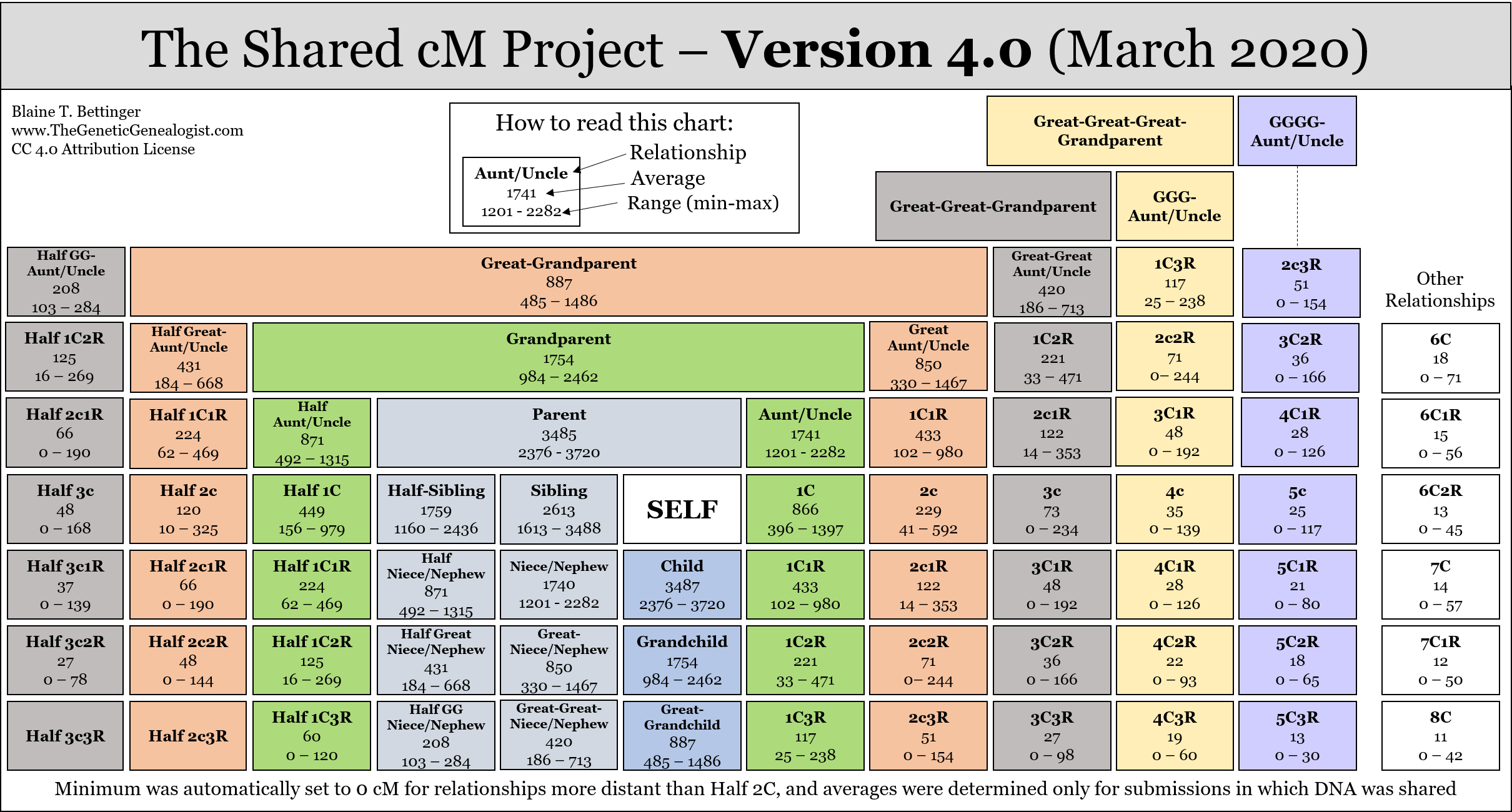
The DNA matches were close enough that it seemed Aurora's father either had to be Vicente himself, or one of his two eldest sons, Everardo (1872-1913) or Vicente, Jr. (b. c1876). Everardo was later ruled out as a possible candidate: he has a living grandson, E.R., who happened to do an AncestryDNA test, and matched my father only with 39cM (for centimorgans, stretches of chromosomes) of shared DNA. If Everardo was Aurora's father, then E.R. and my father would be half first cousins once removed. This is where data from Blaine Bettinger and The Shared cM Project becomes essential. This project compiles a large amount of data from genetic genealogists regarding known relationships between pairs of individuals and the amount of DNA they share. For example, they compile data on first cousins and then document the attested range of shared DNA between individuals with that relationship. The result is ranges and averages per relationship, as summarized in the following chart (available here).
 |
From this we learn that, of 605 documented relationships of half first cousins once removed (that data here), none had fewer than 62cM of shared DNA, and the average is in fact 224cM. (E.R. also only had 54cM of shared DNA with a first cousin of my father, J.O.) This then left either Vicente, Sr. or Vicente, Jr. as possible fathers, and here it became more difficult to discern between the two, until recently. This week, I checked 23andMe for possible new DNA matches, and came across an important one, J.M. He is the grandson of Maximiano Méndez (1859-1914), full brother to Vicente, Sr. If Vicente, Sr., were Aurora's father, then J.M. and my father would be full second cousins once removed, and indeed their shared DNA of 91cM falls within the range of 14-353cM. My father's sister matched J.M. in the low end of the range (36cM), but a first cousin of theirs (P.O.) shared no DNA with him whatsoever. Of the 5,281 instances of second cousins once removed in The Shared cM Project, there were no instances of no shared DNA between cousins of this sort. However, if Vicente, Jr. was the father, this would put my father and his sister (and non-matching P.O.) one generation lower, that is, second cousins twice removed with J.M. And indeed it is attested that second cousins twice removed can share no DNA. Crucially, it was the combination of having a high-generation relative outside of Vicente, Sr.'s descent and a non-match from P.O. that allowed me to pick out Vicente, Jr. and not Vicente, Sr. as the father. With this some of the earliest DNA matches with Méndez relatives fall into place. The first to set off this inquiry, O.C., matches my father at 161cM, within 23andMe's predicted second- to third-cousin range. Indeed her grandmother is Vicente, Jr.'s full sister: O.C. and my father are second cousins once removed.
Now who was Vicente Méndez Granado, and what light does this shine on the story I opened with? So far he is relatively mysterious. I have yet to uncover a paper trail on him from before October 1910, when he married María Murillo Valenzuela in Parral, with a self-reported age of 34. Yet he is the only one of his (half-)siblings born between 1872 and 1914 that I have not located a civil birth record for (or a baptism, at least between 1876 and 1879). The baptism could be in another nearby town, but he was also born during a period when it seems his parents moved from Valle de Zaragoza to Parral, and his birth may never have been recorded and he may never have been baptized. After 1910, there is no easy-to-find record of him: in the 1930 Mexican census, his wife lists herself as a widow, as she does when she registered her son's 1922 birth in 1937. (There she says this was the fourth child born to her and her husband, but there are no civil birth records of other children -- perhaps they died in infancy.) Descendants of this son (Aurora's half-brother) who I have been in contact with say that Vicente, Jr. died shortly before or right after the birth of the son (1922), but there is no civil death record in Chihuahua state, which were quite common by this period. That suggests he moved elsewhere.
Furthermore, what light does this shed on the story of Mauro, María Enríquez, and their apparent daughter Aurora? For all we know, Mauro truly believed Aurora was his daughter. But one also gets the sense that Aurora's maternal family kept her from Mauro purposely, that there was a deeper secret than the marital infidelity that was not uncommon at the time. Perhaps they knew that Mauro was not Aurora's father, or knew that it was not certain and could not reveal that. These are just speculations, and require more sleuthing. What we do know is that Mauro was a kind man who struck up an especially warm correspondence with his son-in-law, Richard O'Hagan, in the 1920s and '30s. They had a shared passion as mechanics, and for shortwave radios. My goal is not to besmirch these familial ties, but to use the genetic clues that survive in descendants to home in on the truth of a period that few were willing to discuss afterwards, at a distance -- over 120 years later -- when it is more appropriate to do so.
 |
| Aurora with her husband Richard & 4 of their 13 children, mid-1920s (photo courtesy of E. Parchim) |
Comments
Post a Comment